
 Türkçe

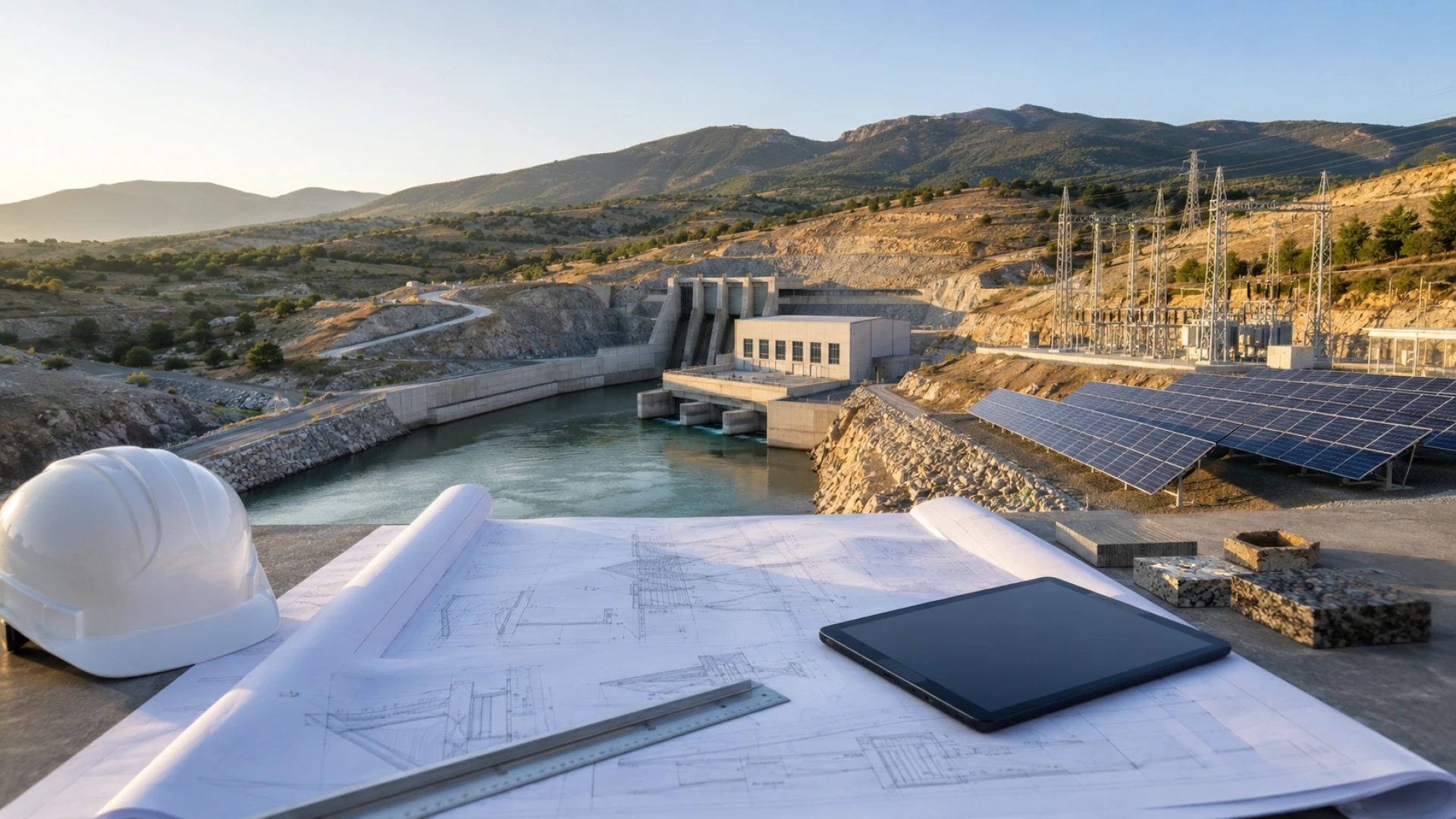
The energy project development process transforms a resource or site concept into a technically feasible, financially sustainable, and operable facility. Determining generation potential alone is not sufficient for a successful investment; regulatory, land, interconnection, financing, engineering, procurement, construction, commissioning, and operational decisions must be managed in alignment. This guide explains the stages an energy project moves through, from preliminary assessment and feasibility to investment approval, implementation, and long-term operations, as well as how critical decisions should be addressed.
1. What objectives should guide an energy investment?
An energy investment should begin by clearly defining its objective before selecting a technology or site. The investor must determine whether the project is intended to generate electricity, meet self-consumption needs, manage energy costs, diversify a portfolio, or create long-term investment value. A clearly defined investment objective becomes the benchmark for evaluating every subsequent technical and commercial decision.
The initial assessment should consider the investor’s capital structure, risk approach, expected operating model, and decision timeline together. Hydropower, solar, wind, geothermal, or hybrid system options should not be compared solely on theoretical generation capacity. Resource continuity, physical site characteristics, grid access, permitting requirements, environmental impacts, and operational needs must also be evaluated.
Which questions should be answered at the outset?
The project development team should turn the investment concept into a measurable project definition. Recording assumptions at an early stage makes it easier to track scope changes and the rationale behind decisions as development progresses.
- What is the investment’s primary objective and expected value proposition?
- Which energy resource and generation model will be evaluated?
- What are the investor’s capital, schedule, and risk limits?
- How will the generated energy be sold or consumed?
- Who will be responsible for developing and operating the project?
2. How does pre-feasibility test the project concept?
Pre-feasibility tests the project’s basic viability before significant resources are committed to detailed engineering. At this stage, the energy resource, site, approximate installed capacity, grid interconnection, land use, access conditions, and principal permitting requirements are assessed at a high level. The objective is not to produce a final investment conclusion, but to identify areas requiring further study and critical obstacles that could stop the project.
The quality of resource data is central to this assessment. The measurement period, data source, seasonal variations, and assumptions directly affect expected generation. Although desktop data may be used for initial screening, it should be supported by field measurements, technical investigations, and independent verification before an investment decision is made.
What does the site and resource review include?
The scope of review varies by energy technology. Flow and head are prominent in hydropower projects, irradiation and shading in solar projects, wind speed distribution in wind projects, and reservoir characteristics in geothermal projects. Nevertheless, every project has a common assessment framework.
- Resource potential and data reliability
- Topography, geology, and ground conditions
- Land ownership, usage rights, and accessibility
- Grid interconnection point and potential capacity constraints
- Environmental and social sensitivities
- Logistics, construction, and operational access
Strong energy project feasibility does more than calculate expected generation; it also exposes the uncertainties that could alter the investment decision.
3. How does detailed feasibility support investment decisions?
Detailed feasibility combines the technical solution and the investment’s economic outcomes within a single decision model. Generation estimates, capital expenditures, operating costs, revenue structure, financing arrangements, and risk scenarios are evaluated together. A feasibility report is a decision tool, not an approval document; its primary purpose is to show under which assumptions the investment may be viable.
An assessment based on a single optimistic scenario does not represent the investment’s actual risk profile. Alternative scenarios should address resource variability, market conditions, interconnection delays, cost increases, currency exposure, equipment performance, and unplanned outages. This allows management to see not only the expected return but also which variables have the greatest influence on the outcome.
What should a feasibility package contain?
The level of detail may vary according to project size and development stage. However, technical, legal, environmental, and financial analyses must use consistent assumptions. A change to a fundamental assumption in one section should be reflected systematically in every related calculation.
- Resource analysis and net energy generation estimate
- Technology selection and comparison of alternative solutions
- Capital, operating, and replacement expenditures
- Revenue model, cash flow, and sensitivity analysis
- Permitting, land, interconnection, and contract status
- Technical, commercial, environmental, and schedule risks
4. How should permits, environment, and interconnection be managed?
In energy investments, permitting and interconnection processes are not supporting activities within the project schedule; they are part of the primary development path. Licensing or unlicensed generation requirements, zoning decisions, land rights, environmental assessments, agency opinions, and grid interconnection requirements should be tracked early through a permitting matrix. A delay in one approval can directly affect engineering and procurement decisions.
Environmental and social assessment should not be conducted solely for regulatory compliance. Water use, ecosystems, land use, noise, traffic, waste, local livelihoods, and stakeholder expectations may influence project design. Early stakeholder engagement helps identify potential concerns and incorporate practical mitigation measures into the project scope in a timely manner.
How should the permitting schedule be controlled?
For each application, the responsible party, prerequisites, required documents, target date, and dependent activities should be defined. Permitting status should be updated together with the master project schedule, and the impact of delays on financing, contracts, or mobilization should be assessed regularly.
- Prepare an inventory of required permits and agency opinions
- Verify land rights and project boundaries
- Incorporate interconnection conditions into the technical design
- Add environmental obligations to the implementation plan
- Manage stakeholder engagement through documented and traceable processes
- Identify critical dependencies within the project schedule
5. How are engineering and financing structures integrated?
The engineering solution should be developed not merely to reduce the initial investment cost, but to ensure safe and efficient performance throughout the facility’s life cycle. As the project advances from conceptual design to basic and detailed engineering, capacity, equipment layout, electrical and mechanical systems, civil works, automation, protection, metering, and maintenance access should be considered together.
The financing model cannot be developed independently of the technical scope. Lenders and investment partners may evaluate the reliability of generation estimates, contract allocation, guarantees, insurance, contractor qualifications, and completion risk. Technical documents, budgets, cash flows, and principal contracts must therefore remain consistent with one another.
Which documents should mature before investment approval?
Every detail may not need to be finalized before the investment decision; however, uncertainties that could materially affect cost, schedule, or performance should be reduced to an acceptable level. Management should clearly understand who owns the remaining risks and which mechanisms will be used to control them.
- Approved design criteria and technical scope
- Updated investment budget and financing plan
- Implementation schedule and critical path analysis
- Procurement and contractor strategy
- Revenue, interconnection, and land agreements
- Risk register, assigned owners, and mitigation plans
6. How should procurement and implementation be controlled?
Implementation is the stage when feasibility assumptions are converted into physical assets in the field. The contracting model should reflect the investor’s management capacity, project complexity, number of interfaces, and preferred risk allocation. Turnkey, multi-package, and hybrid models create different requirements for cost control, flexibility, and coordination.
Purchase price should not be the sole criterion for equipment selection. Technical suitability, efficiency, delivery time, spare-parts availability, service capability, warranty terms, compatibility with digital systems, and expected service life should be assessed together. Early identification of long-lead components helps establish a realistic implementation schedule.
What are the main control areas during site execution?
Project management should coordinate the interfaces among design, procurement, manufacturing, logistics, construction, and installation teams. Change requests should not be approved before their effects on the budget, schedule, permits, and operational outcomes are assessed alongside the technical impact.
- Occupational health, safety, and environmental practices
- Design, manufacturing, and site quality controls
- Schedule, progress payment, and cost monitoring
- Material acceptance and document management
- Technical interfaces among contractors
- Management of changes, nonconformities, and corrective actions
7. Why are commissioning and acceptance critically important?
Commissioning is more than starting completed components; it verifies that the facility operates as an integrated system in accordance with design criteria, safety requirements, and grid conditions. Test plans should be prepared before implementation is complete, system and subsystem boundaries should be clearly defined, and acceptance criteria should be aligned with the contracts.
Cold and hot tests, protection checks, communication trials, performance measurements, and safety verifications should be documented. Outstanding items should be classified by severity, and final acceptance should not occur before they are closed. Early involvement of the operations team transfers field knowledge into organizational memory and enables the facility to be handed over in a more controlled manner.
What should the handover package contain?
A complete handover accelerates troubleshooting and maintenance during operations. Documents must not only be delivered; they must also be current, searchable, and consistent with the facility’s final configuration. The digital document structure, equipment codes, and maintenance system should be aligned.
- As-built drawings and technical calculations
- Test, inspection, and performance records
- Equipment manuals and warranty documents
- Spare-parts and special-tool lists
- Operating, maintenance, and emergency procedures
- Training records and the closeout plan for outstanding work
8. How are operational performance and investment value protected?
The energy project development process does not end with provisional acceptance; it becomes a continuous management cycle informed by operating data. Generation, availability, efficiency, losses, failures, maintenance costs, safety incidents, and environmental obligations should be monitored regularly. Comparing actual results with feasibility assumptions reveals the causes of performance deviations.
The maintenance strategy should reflect equipment criticality and the consequences of failure. Preventive maintenance, predictive monitoring, spare-parts management, and a competent technical team complement one another. An approach based solely on responding after failure may increase downtime and unexpected costs, while excessive maintenance can result in inefficient use of resources.
Which indicators should be monitored in life-cycle management?
The indicator set should extend beyond generation volume to reflect technical reliability and the investment’s long-term condition. Management reports should distinguish between causes the operations team can address and effects arising from external conditions.
- Net generation and performance against budget
- Availability, capacity, and loss indicators
- Planned and unplanned downtime
- Maintenance costs and critical equipment condition
- Occupational safety and environmental compliance performance
- Revenue, cash flow, and contractual obligations
An integrated approach from feasibility through operations keeps technical decisions aligned with financial objectives and field realities. As reflected in KTM Group’s energy, engineering, project, and consulting approach, managing every stage of the investment through a shared risk register, current data, and clear accountability does not eliminate uncertainty, but it improves decision quality and helps protect the facility’s long-term value.

